
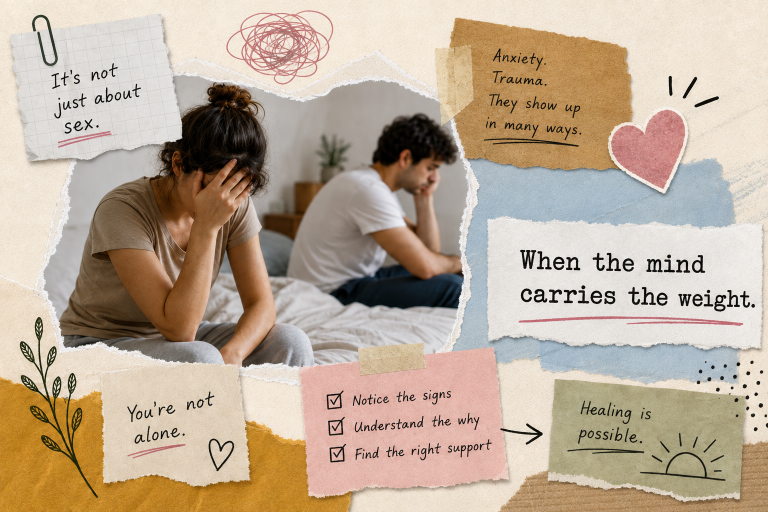
Picture this: you used to look forward to sex and physical closeness. Now you find yourself making excuses, feeling strangely disconnected from your own body, or quietly dreading something that once felt natural. You’ve probably Googled your symptoms. You’ve probably landed on a list of physical conditions and wondered which one applies to you.
But here’s what those search results often miss: for many people, the root cause of sexual difficulties isn’t physical at all. It lives in the nervous system, in unprocessed memories, or in the low hum of anxiety that follows you from one part of your life into the bedroom. These patterns are common but under-discussed, and they’re also genuinely treatable. At Self-Compassion Pathways, Dr. Coralis Solomon works with individuals and couples navigating these exact challenges in Orlando and across Florida, in English and in Spanish, without shame attached. What follows is a clear-eyed look at what anxiety and trauma actually do to sexual function, what else might be playing a role, what you can try right now, and how to recognize when working with a therapist is the right move.
How anxiety quietly shuts down desire and sexual function
Anxiety and sexual arousal are not just emotionally incompatible. They are biologically competing states.
Sexual arousal depends on the parasympathetic nervous system, the branch responsible for rest, digestion, and connection. Anxiety activates the sympathetic nervous system, the branch that prepares the body to fight, flee, or freeze. When anxiety is present, even at a low, background level, the body prioritizes self-protection over pleasure. Blood flow shifts away from the genitals. Lubrication, erection, and arousal become harder to initiate. Orgasm may feel out of reach. This is not a personal failing. It’s physiology.
Performance anxiety follows a particularly stubborn pattern. One difficult sexual experience creates fear of the next one. That fear produces the very outcome it’s trying to avoid, which reinforces the fear further. Generalized anxiety works differently but causes real damage too. It drains mental and physical bandwidth across the board, leaving little room for desire, presence, or pleasure. Both types respond to treatment.
There’s also a shame layer that compounds the whole thing. Feeling anxious about sex tends to produce shame. Shame increases anxiety. Increased anxiety makes sexual difficulty more likely. Recognizing this cycle is the first step toward interrupting it.
When past trauma resurfaces during sex and intimacy

Trauma doesn’t stay neatly filed away once the event is over. For many people, specific sensations, positions, smells, or emotional dynamics during sex can trigger a full nervous system response, even in a relationship built on genuine trust and care. This isn’t evidence that something is permanently broken. It’s the nervous system doing exactly what it was designed to do: protect you from something it has learned to perceive as dangerous.
Trauma responses during sex aren’t always dramatic or obvious. Sometimes they look like emotional shutdown, sudden irritability, an urgent need to stop, or feeling physically numb. Sometimes they’re quieter: zoning out, feeling vaguely unsafe without being able to name why, or gradually avoiding sexual intimacy over weeks and months without a clear explanation. Partners often misread these responses as rejection, which adds relational pain on top of the original wound.
Sexual or relational trauma in particular tends to create a disconnect between the mind and the body. A person may genuinely want closeness and connection while their body remains in a state of alert, refusing to cooperate. Understanding that gap as a trauma response, rather than a character flaw or proof that intimacy is impossible, is where the healing process usually begins. The body can be reached. It takes the right approach and enough safety to do it.
Medications, health conditions, and relationship patterns also play a role
 Anxiety and trauma are major contributors, but they aren’t the only ones. A complete picture of sexual difficulty often includes what’s going into the body and what’s happening between two people.
Several commonly prescribed medications list sexual side effects that patients may not always be told about. SSRIs and SNRIs, two of the most widely prescribed antidepressants, are among the most frequent culprits, affecting libido, arousal, and the ability to orgasm. Some SSRIs carry a higher risk of sexual side effects than others, which is worth discussing specifically with a prescribing provider. Blood pressure medications, antipsychotics, and certain hormonal treatments can all affect sexual function as well. The critical point here is that medication-related sexual difficulties are often adjustable. A prescribing provider can review alternatives, adjust dosing, or suggest workarounds, but only if the conversation happens.
Relationship dynamics deserve attention too. Sexual difficulty rarely exists in a vacuum between two people. Unresolved conflict, fear of rejection, emotional distance, or the habit of avoiding hard conversations all erode desire and connection over time. Clinically, how partners talk about sex and sexual pleasure and intimacy, or avoid talking about it, shapes the sexual relationship profoundly. This is not about assigning blame. It’s about recognizing that intimacy lives inside a relationship, and the relationship needs tending.
Practical, sex-positive strategies to start today
Before reaching for a clinical diagnosis, there are evidence-informed practices that can meaningfully shift anxiety, rebuild a sense of safety in the body, and open up communication between partners.
Mindfulness and sensate focus


Mindfulness and sensate focus are two of the most well-researched starting points. Sensate focus, a technique commonly used in sex therapy, involves non-sexual touch with zero expectation of arousal or intercourse. The goal is to restore comfort with physical closeness gradually, without performance pressure attached. Breathwork and grounding techniques, such as slow diaphragmatic breathing or orienting your attention to physical surroundings, are clinically useful for many people as a way to interrupt an anxiety or trauma response before it escalates.
Grounding techniques
Grounding works by redirecting attention to the present moment and the immediate physical environment, helping the nervous system register safety rather than threat. Simple practices, like pressing your feet into the floor, naming five things you can see, or taking three slow breaths before and during intimacy, can make a real difference over time when practiced consistently.
Communication tips
 Communication is equally practical and often equally avoided. Effective conversations about sexual intimacy are specific, well-timed, and framed around what you want rather than what your partner is doing wrong. Starting with something like, “I’ve been wanting to talk about something, and I need it to feel safe,” lowers defensiveness before the conversation even begins. Identifying your own limits and desires before the conversation, rather than trying to figure them out in the middle of it, reduces the chance of shutdown or misreading. Checking in after intimacy, not just before, helps both people feel seen and builds trust over time.
- Talk outside the moment of initiation or rejection, not during or immediately after.
- Use “I” statements that name feelings rather than assign blame
- Define intimacy broadly enough to include non-sexual closeness so connection doesn’t disappear when desire is uneven
- Revisit boundaries over time, because they’re allowed to change
Signs it’s time to work with a therapist, and what to expect
 Self-help strategies are a real and valid starting point. But some patterns are genuinely difficult to shift without professional support, and recognizing that sooner rather than later saves significant time and pain.
Several clear signals suggest therapy will make a meaningful difference: avoidance that has been building for months with no improvement; recurring panic, dissociation, or emotional shutdown during intimacy; a history of sexual or relational trauma that has never been formally processed; or a couple that keeps circling the same painful dynamic despite genuine effort to break out of it. These situations need more than willpower and better communication scripts. They need skilled, structured support.
Trauma-informed therapy moves at the client’s pace and never requires reliving painful experiences in graphic detail. It prioritizes emotional safety, then nervous system regulation, before gradually and consensually addressing body awareness and intimacy. Techniques like adapted sensate focus, grounding practices, somatic work, and EMDR can help rebuild a felt sense of safety in the body over time. Couples counseling addresses the relational layer: communication patterns, attachment wounds, and the emotional distance that builds when sexual difficulty goes unaddressed.
Dr. Coralis Solomon at Self-Compassion Pathways specializes in exactly these challenges, working with individuals and couples in Orlando and throughout Florida. The practice offers sessions in English and Spanish, with both in-person and telehealth options available for Florida residents. The approach is holistic, non-judgmental, and tailored to each person’s actual life circumstances, not a one-size-fits-all protocol. Whether the issue is recent or has been building quietly for years, many people find that first session far less daunting than they anticipated. Reaching out is a reasonable next step, not a dramatic one.
You’re not broken.
You’re dealing with something real.
 Sexual difficulties tied to anxiety or trauma carry a particular kind of loneliness. It can feel like something is fundamentally wrong with you, like the problem is too personal or too complicated to say out loud, like nobody else is navigating this. None of those things are true.
The connection between sexual health, anxiety, trauma, and emotional wellbeing is well-documented and, more importantly, well-treated. People move through these patterns regularly, not by pushing through or pretending nothing is wrong, but by understanding what’s actually happening and getting support that matches the real problem.
If anything in this article landed close to home, that recognition is worth noticing. Self Compassion Pathways offers compassionate, bilingual, flexible therapy for individuals and couples in Orlando and across Florida. Conversations with Dr. Coralis Solomon often help people see their situation in a new light. You can reach out to schedule an in-person or virtual session directly through the practice.
